


|
Navigation
Recherche
|
China Unveils ‘Electronic Skin’ That Gives Robots Human-Like Reflexes
mardi 30 décembre 2025, 18:11 , par eWeek
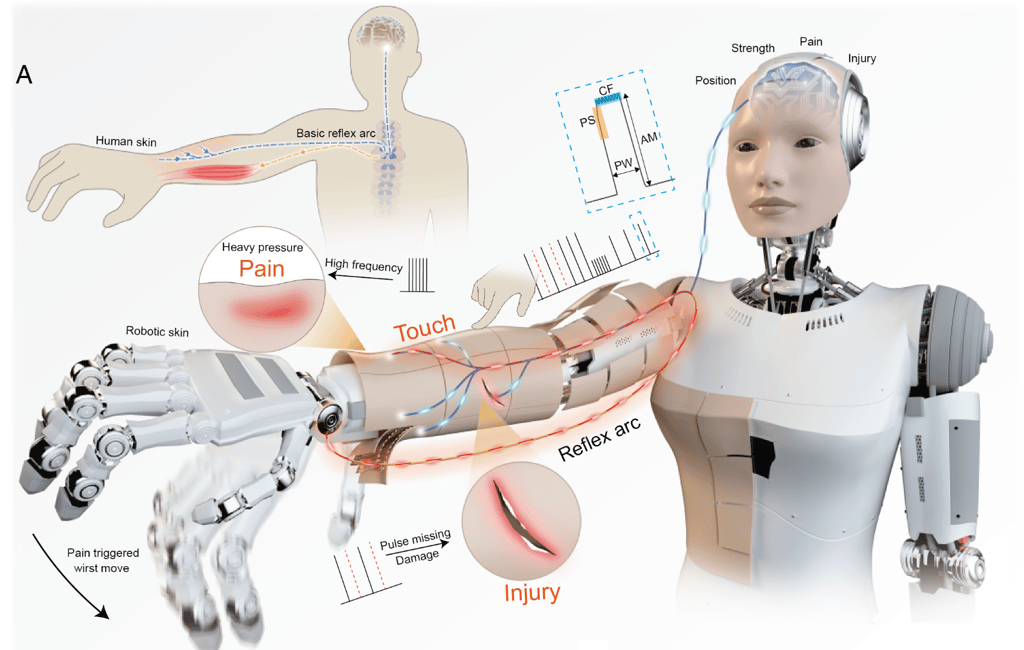
In a major leap for embodied intelligence, researchers in China have developed a “neuromorphic” electronic skin (NRE-skin) that allows robots to experience touch, detect injury, and even react to pain through reflexive movements, mimicking the way the human nervous system protects the body. While most current robotic skins are limited to basic pressure sensing using complex, bulky wiring, this new NRE-skin takes a page out of biology. Human skin is a sophisticated network where nerve endings turn touch into “pulses” for the brain to read. The NRE-skin does the same, converting physical pressure into neural-like pulse trains. According to the research team, this hierarchical design allows the robot to understand not just that it’s being touched, but exactly where and how hard. As Ars Technica reports, this system uses these activity spikes to create “something akin to a bar code that helps identify which sensor the reading came from.” The ‘ouch’ factor: Active pain and reflexes The most striking feature of the NRE-skin is its ability to “feel” pain and react instantly. In humans, a reflex arc allows us to pull our hand away from a hot stove before our brain even processes the heat. The NRE-skin replicates this by building a “pain center” directly into the skin’s circuitry. When pressure hits a dangerous level, the skin triggers an immediate motor reaction, bypassing the robot’s central “brain” to prevent damage. The neuromorphic NRE-skin system. Image: PNAS “Pressure-initiated raw pulses from the pulse generator accumulated in the signal cache center until a predefined pain threshold is surpassed, activating a pain signal,” the researchers explained. In demonstrations, a humanoid robot wearing the skin showed a smiling expression during light touch, but switched to a “painful expression” and pulled its hand away when the pressure became too heavy. Self-sensing wounds and ‘Lego-like’ repairs Beyond just feeling the world, this skin knows when it’s broken. The system performs autonomous “whole-body checks” every five minutes. Each sensor sends a “live pulse” or an “I’m still here” signal. If a pulse is missing, the robot knows exactly where it has been injured. Because artificial materials cannot grow back like human cells, the researchers designed the skin to be modular. Using a “Lego-like” magnetic interface, a damaged section of skin can be snapped off and replaced with a fresh piece in seconds. Once the new piece is attached, it automatically joins the network and begins its own self-checks. Why this matters This development is a significant step toward creating empathetic household assistants that can safely interact with humans. By giving robots a sense of self-preservation and a more nuanced “sense of touch,” they become less like heavy machinery and more like intuitive partners. While the skin currently focuses on pressure, the researchers suggest that future versions could be refined to handle even more complex environments, paving the way for robots that can truly “feel” their way through the world. Want the bigger picture? Don’t miss eWeek’s roundup of the biggest AI moments of 2025, from breakthroughs to the controversies shaping what comes next. The post China Unveils ‘Electronic Skin’ That Gives Robots Human-Like Reflexes appeared first on eWEEK.
https://www.eweek.com/news/china-robots-electronic-skin-human-like-reflexes/
Voir aussi
|

56 sources (32 en français)
Date Actuelle
mar. 30 déc. - 20:22 CET
|
 Lire la suite sur eWeek


