


|
Navigation
Recherche
|
A first look at Google’s new Antigravity IDE
mercredi 3 décembre 2025, 10:00 , par InfoWorld
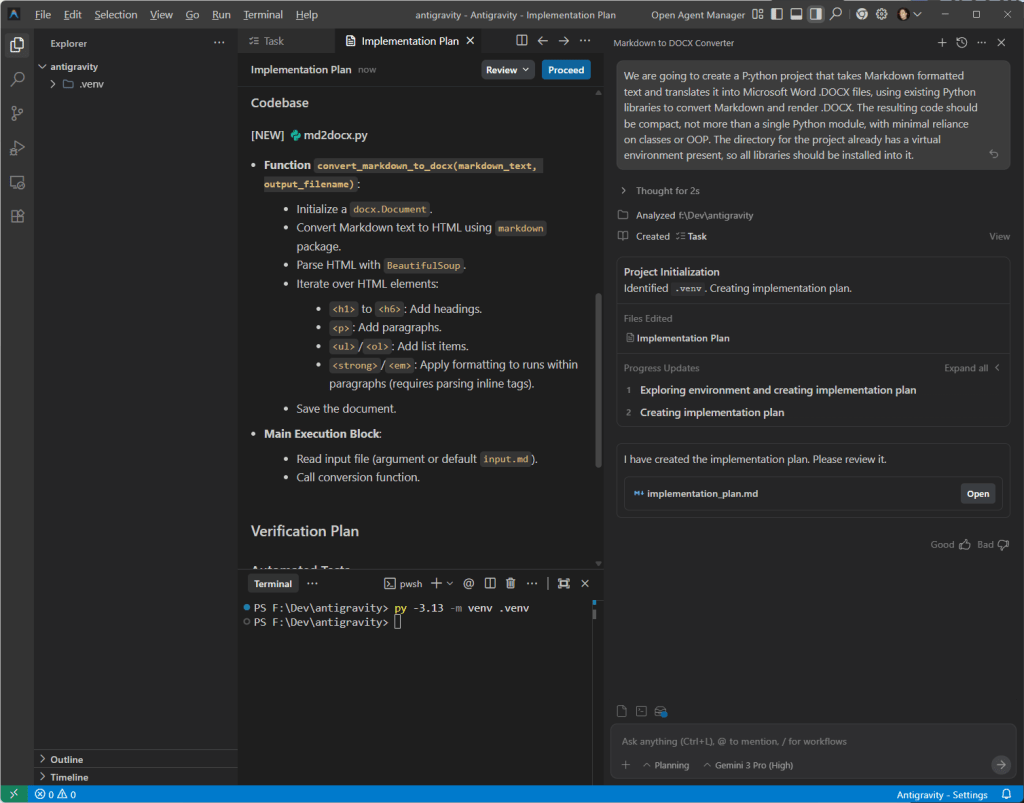
Like Kiro, Antigravity is built from a fork of Visual Studio Code, which integrates Antigravity’s behavior with VS Code’s in ways that presumably wouldn’t be possible with just an extension. If you’ve used VS Code before, getting started with Antigravity is easy enough. But like Kiro, Antigravity’s workflow revolves around interactions with AI agents, which requires some adjustment. Antigravity security concern In a late November blog post, security researcher Mindgard warned of a vulnerability that could put Antigravity users at risk of backdoor attacks. As of this writing, Google says it is working to address the issue. Setting up a project When you open Antigravity and start a new conversation with one of its agents, you can choose one of two interaction modes. Planning mode is more deliberate and generates artifacts of the agent’s thinking process—walkthroughs, task lists, and so on. This mode gives you plenty of opportunity to intervene at each step and decide if a given operation needs modification. Fast mode executes commands directly, so it’s more useful for quick actions that aren’t likely to have major repercussions. Use planning mode for projects where you want more oversight and feedback, and use fast mode for quick-and-dirty, one-and-done experiments. You can also select how much you want to review at each step: never, only when the agent thinks it’s a good idea, or always. Antigravity comes pre-equipped with several agent models. The default, and the one I used for my review, is Gemini 3 Pro (high). The “low” version of Gemini 3 Pro is also available, along with Claude Sonnet 4.5 (both the regular and “thinking” variety), and GPT-OSS 120B Medium. As of this review, the only cost plan available for the models is a no-cost, individual-account public preview, with fixed rate limits refreshed every five hours. Paid tiers and bring-your-own-service plans are not yet supported. Working with the agent My first project in planning mode was a simple Python-based utility for taking a Markdown file and generating a Microsoft Word (.docx) file from it. The first set of commands Antigravity generated did not take advantage of the Python virtual environment already in the project directory, which meant the needed libraries would have been installed in the wrong place. But after I advised the agent, it used the virtual environment correctly for all future Python actions. The implementation plan created by an Antigravity task prompt, shown at top left. Planning mode allows the developer to vet and comment on each plan document and the description of steps.Foundry Once the agent created a basic version of the project, including a task list, walkthrough, and implementation plan, I requested some modifications. One was the ability to provide font styling information for the generated Word file, by way of a JSON file. Another was allowing inline images to also be saved in the generated Word document, and either linked from an external file or embedded. The agent made that last feature work by generating a custom XML fragment to be inserted into the document, since the Office XML library used for the project didn’t support that as an option. An example of code generated by Antigravity, with sample input and output files shown on the left side of the explorer screen.Foundry Whenever you give instructions to the agent, it works up a few different planning documents. The task list describes each high-level goal and whether it’s been completed. The implementation plan goes into verbose detail about how the agent intends to accomplish the current task. The walkthrough provides an aggregate summary of each set of changes made. For each of these, you can provide inline comments as feedback to the agent, much as you would in a Word document, and modify the plan granularly as you go forward. The project implementation plan generated by Antigravity. The developer can provide inline commentary, which the agent will evaluate and use to shape future revisions.Foundry All earlier states of those files are preserved along with your agent conversation history. Antigravity also tracks (where it deems relevant) persistent patterns and insights across conversations in what are called Knowledge Items. One much touted feature for Antigravity’s agent integration is the ability to generate mockups and graphics via Google’s Nano Banana image-generation service. To test this, I asked the agent to generate a mockup for a web UI front end for my application. The failure mode for this turned out to be as interesting as the service itself: When multiple attempts to generate the image failed due to the server being overloaded, the agent fell back to generating the mockup as an actual web page. In some ways that was better, as it allowed me to more readily use the HTML version. Agent-driven browser features Since Antigravity is a Google project, it naturally provides integration with Google Chrome. The agent can be commanded to open instances of Chrome and perform interactive actions (such as opening a web page and extracting text) by way of a manually installed browser plugin. The agent can also, to some extent, work around not having the plugin. For instance, when I didn’t have the Chrome plugin installed and asked for screenshots from a website, the agent worked up an alternate plan to use a Python script and an automation framework to get the job done. While it’s convenient to tell the agent to operate the browser, as opposed to writing a Python program to drive a browser-automation library like Playwright, the agent doesn’t always give you predictable outcomes. When I tried to extract a list of the most recent movies reviewed on RogerEbert.com from its front page, the agent scrolled down slightly (it even admitted to doing this, but didn’t specify a reason why) and missed a few of the titles at the very top of the page. Writing a script to automate the scraping generated more reproducible results. Limitations and quirks of using Antigravity Working with agentic AI is hardly bulletproof, and my experiences with Gemini in Antigravity included a few misfires. At one point the agent mistakenly duplicated an entire section of the code for my project. It caught the mistake, but only by chance while working on an unrelated part of the project. I also ran into a few quirks specific to the IDE. For instance, if you create an Antigravity project directory and move it somewhere else on the system, some things may break silently, like the retention of Knowledge Items. There is currently no obvious way to fix this problem. Conclusion The main selling point for IDEs with agentic AI integration is having one context for all of your work. Instead of stitching together a suite of multiple applications, or even one app with multiple plugins, both Antigravity and its competitor, Kiro, present a unified workspace. And like Kiro, Antigravity uses a prompt-and-spec driven process for iterative development. The biggest difference between the two IDEs, at this stage, is in the models each one offers. Kiro is limited to Claude Sonnet 4.0 and 4.5, whereas Antigravity offers Sonnet and others (mainly Gemini). Both are still limited to external APIs for their models. Even if you had the hardware to host a model locally, you couldn’t use Antigravity with it—at least not yet. Antigravity doesn’t have Kiro’s more development-workflow-centric features, like the hooks that can be defined to trigger agent behaviors at certain points (e.g., saving a file). The product is still in an early enough stage, though. It is likely Google is focusing on the core agentic functions—the behavior of the user feedback loop, for instance—before adding a broader set of developer features and bringing the product to a full-blown initial release.
https://www.infoworld.com/article/4096113/a-first-look-at-googles-new-antigravity-ide.html
Voir aussi
|

56 sources (32 en français)
Date Actuelle
jeu. 25 déc. - 04:36 CET
|
 Lire la suite sur InfoWorld


